Posts

Showing posts with the label ex-christian

How Famines and Poison Berries Demonstrate a Non-existent (or Uncaring) God

Image
Many people often gush about how the Christian God has blessed their lives. He has provided food, shelter, medicine, and the joys of life.  People pray before meals, thanking God for his generosity and for the food on their plate. Everything good is from God. There are many Bible verses that back this up, too.   "And God is able to bless you abundantly, so that in all things at all times, having all that you need, you will abound in every good work." 2 Corinthians 9:8 "Consider the ravens: They do not sow or reap, they have no storeroom or barn; yet God feeds them. And how much more valuable you are than birds!"  Luke 12:24 "So do not worry, saying, ‘What shall we eat?’ or ‘What shall we drink?’ or ‘What shall we wear?’"  Matthew 6:31 "Everything that lives and moves about will be food for you. Just as I gave you the green plants, I now give you everything." Genesis 9:3 But have they ever stopped to think -- for just a moment -- about whether God...
Is God entitled to kill us?

Image
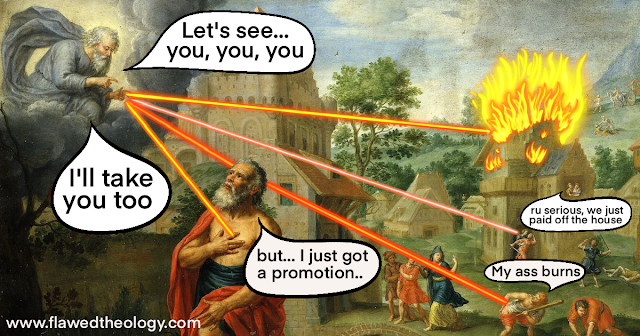
I have been stewing over this post for awhile.  My usual method of addressing Christian arguments is by poking holes in them, by lining up logical fallacies that are undeniable, and by making cracks in the foundations until the argument starts to crumble. But this one's different. It's personal.   It can't be attacked head-on with a spear of logic. Instead, we as humans must gather up our senses of worth, identities, and individualities, and stand up to say,  I have value.  I am not disposable. OK, what am I talking about, you ask?   This all started when I began writing a post about all the killing that God does in the Bible.  In general, when I write a post, I research the Christian side of the argument -- to see if it has merit, and to see how best to refute it. I could not believe my eyes what I saw what one Christian wrote in defense of God.  According to John Piper: "It's right for God to slaughter women and children anytime he pleases. God...

Six times God killed people in the Bible

God killed way more people than Satan ever did.  According to John Piper, God is still pretty hands-on at killing people today. But virtually all Christian denominations claim that God is  morally perfect and without sin.   Therefore, any action performed by God are by definition moral, and are not a sin.  Meaning, it was theoretically moral for God to perform the following acts (and this list is not exhaustive): 1. God murders everyone in Sodom and Gomorrah, then turns a lady to salt (Genesis 18-19) Apparently everyone in the cities were evil, even the children and animals.  After God destroyed the cities, he turned Lot's wife to salt for the sin of...curiosity?  2. God kills all Egyptian firstborn sons during Passover ( Exodus 11-12) The final plague against the Pharaoh is the elimination of the firstborn son of every living thing--including cattle.   Presumably these firstborns didn't even have anything  to do with the conflict betwee...

God's Morality Should Never Change

Image
A very common argument in favor of theism is that morality is objective and it must come from God.  For something to be objective, it must have a truth value independent of everything.  So objective morality depends on nothing--not the era, nor the place, nor the entity performing the action-- so by definition, it never changes.  If objective morality exists and it comes from God, then we should be able to see the unchanging nature of morality over time--both within the Bible itself, and when comparing the Bible to modern times. Let's see how this holds up! Old Testament Morality Slavery: In Biblical times, slavery was totally fine. This included not only indentured servitude, but children born into slavery, captives of war, and women sold into slavery against their will (as sex slaves).  This was all accepted.  See Exodus 21,  Leviticus 25, Deuteronomy 15.  No matter how much Christians try to account for this, slavery is a huge issue in the Bible....

Thought Experiment: Let's Invent a Fake Religion!

Image
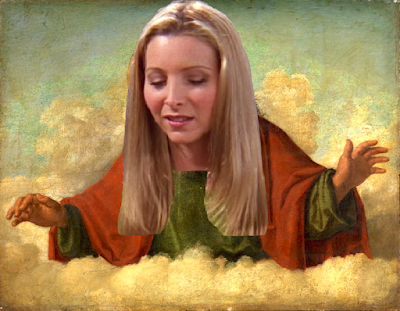
Let's create a deity and a religion associated with that deity.  For this exercise, it isn't really relevant whether we, as the creators of the deity, actually believe that the deity exists--we're just trying to see what it would take to build a religion around an imagined deity and convince people of it. Name of deity: Let's pick a name and apply an arbitrary gender.  How about... Regina Phalange, female.*  Our religion will be called Reginianity. Regina Phalange, friend to everyone Characteristics:  We want people to be impressed with Regina Phalange and not follow any other deities.  So let's make her all-powerful . She's so powerful she made the entire universe. We want people to love Regina.  Let's make her all-loving and benevolent ! We want people to trust Regina.  Let's make her very very wise. She's omniscient ! How to spread the news about Regina Phalange? Since Regina isn't about to go door-to-door introducing herself (she isn't r...

Did Jesus ride two donkeys into Jerusalem?

Image
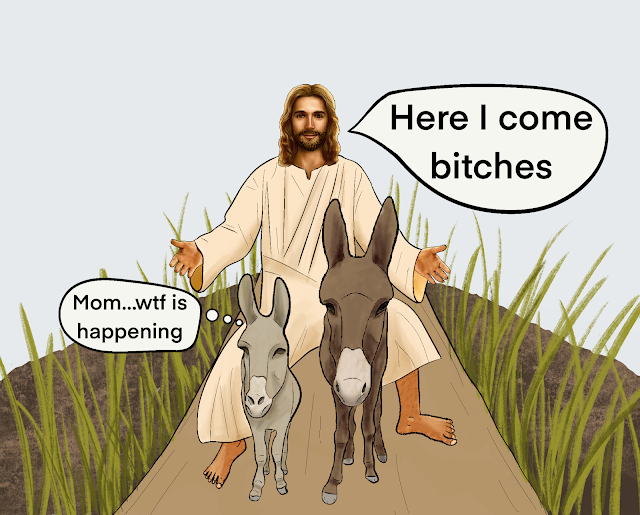
Many are familiar with the story of Jesus riding majestically into Jerusalem on a donkey during the Triumphal Entry. What you MAY not know is that in the gospel of Matthew, Jesus rides into town on TWO DONKEYS.   Count 'em: two.  A mother donkey and her colt. It's unclear how Jesus was able to physically ride on two donkeys at once, especially when they were two different sizes.  Maybe something like this:  The most plausible donkey configuration...another possibility is to ride them like water skis But this little bit of weirdness in Matthew's gospel is overwhelming evidence that the anonymous author of Matthew was INVENTING fiction in order to fulfill Old Testament prophecy--or at least, what he UNDERSTOOD to be OT prophecy. In order for fulfilled prophecy to be actually compelling, it has to be something like this: Prophecy is written down Events actually happen that fulfill the prophecy Documentation is written about the events If Step #2 does not occur, the...

The Zombie Uprising in Matthew's Gospel

Image
Matthew 27 describes a truly astonishing and moderately creepy event that took place right after Jesus died.  The temple curtain was torn in two, there was an earthquake, and THEN...the tombs opened and many saints who had been long dead were RAISED BACK TO LIFE.   The zombies then went into the holy city, wandered around, and appeared to many (Mt 27:52-53). Actual photo evidence of the zombie uprising This is quite a thing.  If this actually happened, it should go down as one of the most astounding and miraculous things that has ever happened on this planet in all of recordable time.   So here are my thoughts: Matthew is the only gospel account that includes the zombie anecdote.  If zombies were REALLY wandering around the city, doesn't it seem odd that only Matthew wrote about this?  Did Mark, Luke, and John not know about it, or not care to write about it?  Did they not think it was important to document that people came back to life? There a...

Can we be moral without God?

The argument that we cannot be moral without God usually consists of two parts: Human morality comes directly from God Without God, there is no objective morality Let's assume God does indeed give us moral commands. Are these commands: Moral because God commanded them*?  OR Were they already moral before God commanded them? *This is called the divine command theory Obviously, those who insist that morality comes from God MUST say #1 is true.  But this also means that God subjectively decides which acts are moral.  He could command genocide ( and has ) and it would be a moral act, simply because he commanded it.  This also means that there is no objective morality--since God can decide what acts are moral, it is subjective. To avoid this problem, one might say #2 is true. But if God is merely commanding acts that are already moral, then morality exists outside of God, and we don't need God for morality. A good test to see which of #1 or #2 is true: If God commanded yo...

Why be a good person?

There are many people who claim that morality comes from a god . And they often say, "If there is no god, then why be a good person?" There are many reasons to be a good and moral person. To maximize the health and safety of people around us To treat people how we would want to be treated To minimize human suffering To exercise our natural instincts for compassion To earn the respect and trust of others To feel a sense of purpose To minimize the time spent in conflict with those around us To lower the amount of stress we feel To improve our mental health Many more, I'm sure...let me know in the comments. Let's revisit the claim that we can only be good with god. Does that mean: If there weren't a god in the sky watching you, you wouldn't be good? You are only being moral to earn some kind of reward or to avoid punishment? You would follow any command from your god no matter how depraved (since morality comes from your god?) Which person seems more moral: the ...

27 Puzzling Questions about Christianity

Ask these questions to a Christian and start some fun discussions.  But make it clear that the Christian is not allowed to answer the questions with any of the following cop-outs: God works in mysterious ways We cannot possibly understand God Suffering is necessary for free will You need more faith/Pray about it You're taking it out of context That's just your interpretation (without providing a satisfying interpretation themselves) The Bible is true because it says it's true (or any other circular reasoning) God has a plan, we just don't know what it is 27 Puzzling Questions about Christianity Is Satan omniscient and all-powerful? If not, why doesn't God just get rid of him? If suffering on earth cannot be eliminated because we need to have free will, then is there free will in heaven? Where did God come from? Why did God create humans with a biological need to eat, but then not provide enough food for us (9 million people die each year of hunger)?  Doesn't tha...

Childhood Indoctrination: Creating Christians

Image
A child is not a Christian child, not a Muslim child, but a child of Christian parents or a child of Muslim parents. -Richard Dawkins, The God Delusion What is indoctrination? According to Oxford Languages, it is "the process of teaching a person or group to accept a set of beliefs uncritically."   I'm not aware of any religious institutions that teach their parishioners how to critically examine the religion being taught. No, the religion is presented as non-negotiable truth and any real scrutiny is discouraged.  This is especially true for children.  Children are taught at an early age by their parents that their chosen religion is fact.  Kids are not taught how to think, but what to think.   Indoctrination exposes children to what is inside the bubble, at the expense of the virtues outside of the bubble In The God Delusion , Richard Dawkins compares religion to "mind-viruses".  The religions that are most likely to be spread from person to pers...

Doubting religion? There is nothing wrong with you. Take off the Blinders.

Until very recently, I thought there was something wrong with me.  Everyone around me seemed to happily accept the religion they were given with no questions asked.  If anyone besides me ever doubted, I never saw it. It is extremely isolating to be the only one among your family and church friends to question the reality with which we are presented. I thought the reason I couldn't accept Christianity was because of who I was as a person. I was too curious, too logical, too rebellious, too disobedient.  I often wished I had been born differently. Couldn't I have been given more of a pliable mind? What if I were just a tad more gullible? Maybe then I could be convinced that the Bible is true. That this invisible entity that I couldn't feel, touch, or hear is actually there. These feelings eventually turned into guilt.  I tearfully admitted to my best friend that I didn't have any faith, but I wished I had some.  I asked her why it was so easy for her, why was it s...

Frank Turek Rebuttal: What is faith? And why everyone has it!

I recently listened to a Frank Turek Podcast : "What is faith? And why everyone has it!" "Faith is not blind. Faith is trusting in what you have good evidence to believe is true." - Frank Turek In the first part of this podcast, he makes the claim that "faith is trusting in God for an unseen future, based on the evidence of what is already known about God."  In other words, this faith is not blind because God has proven himself with the following "historical facts". The resurrection Jesus's miracles God taking the Israelites out of Egypt and into the promised land What Mr. Turek is not addressing is that these "historical events" are far from fact.  To say that they are factual is in itself a leap of faith.  Let's briefly look at each of these. The Resurrection and Miracles The argument that Jesus performed miracles and rose from the dead all hinges on the historical reliability of the Bible--the gospels in particular.  If you a...